
How to Save a Dying Tree in Utah

Is My Tree Dying or Just Stressed?
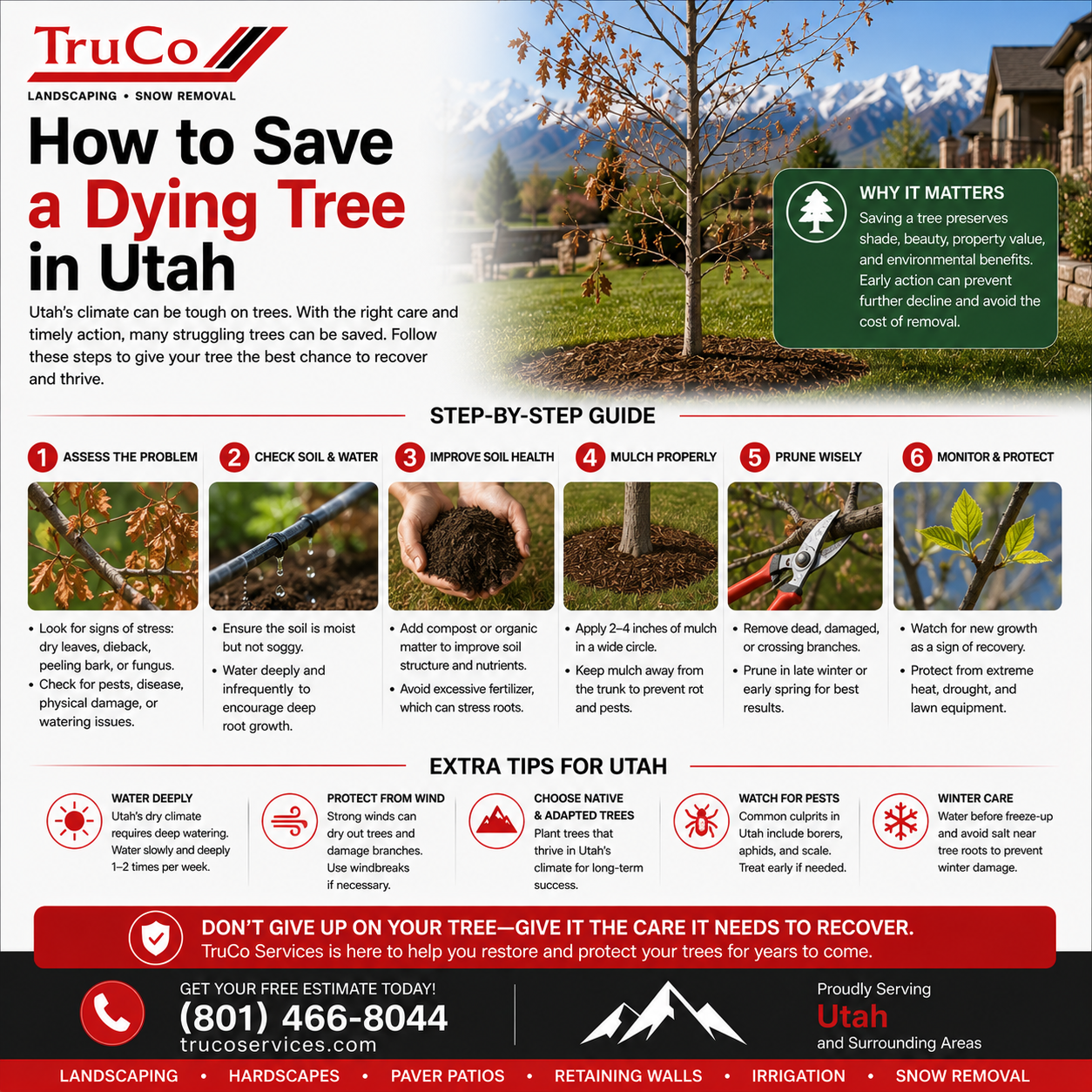
Many trees in Utah that appear to be dying are actually just stressed. Stress is reversible; death is not. The difference: stressed trees have some healthy growth, produce new leaves (though they may be small), and have live bark underneath. Dying trees have no new growth, large sections of dead canopy, peeling bark with no live tissue underneath, and fungal growth on the trunk. Key to saving a stressed tree: identify and address the stressor quickly.
Step 1: Diagnose the Problem
Common tree problems in Utah: drought stress (most common), overwatering in clay soil (root rot), nutrient deficiencies (iron chlorosis in alkaline soil), disease (fire blight, cytospora canker), pest infestations (borers, aphids), physical damage (lawn mower injury, construction damage), and winter desiccation (evergreen needle browning). Look at the whole picture: where is the damage? When did it start? What has changed recently?
Drought Stress: The #1 Killer in Utah
Utah's semi-arid climate means trees are often drought-stressed, especially during July-September. Symptoms: wilting leaves, leaf scorch (brown edges), premature fall color, thin canopy, small leaves. Treatment: deep water to 12-18 inches depth at the dripline. Water once a week during dry periods. Apply 3-4 inches of organic mulch. Do NOT fertilize a drought-stressed tree — fertilizer can burn stressed roots. Recovery takes 1-3 years with consistent care.
Overwatering and Root Rot in Clay Soil
Utah's clay soil holds moisture much longer than homeowners expect. Overwatering is as common as underwatering. Symptoms: yellowing leaves, fungal growth at tree base, algae on soil surface, foul smell from soil, sudden branch death. Treatment: stop watering immediately. Allow soil to dry completely between waterings. Improve drainage around the tree. Remove mulch if it's more than 4 inches deep. In severe cases, install drainage tiles or aeration tubes.
Nutrient Deficiencies in Alkaline Soil
Utah's alkaline soil (pH 7.5-8.5) locks up iron, making it unavailable to trees. Iron chlorosis is common in maple, aspen, oak, and birch. Symptoms: yellow leaves with green veins (interveinal chlorosis), stunted growth, leaf drop. Treatment: apply chelated iron to the soil or as a foliar spray. Acidify the soil with elemental sulfur or ammonium sulfate. USU Extension recommends soil testing to confirm deficiency before treating.
Disease and Pest Infestations
Common Utah tree diseases: fire blight (apple/pear), cytospora canker (spruce), verticillium wilt (maple/ash). Common pests: bark beetles (pine/spruce), aphids (many species), scale insects. Treatment: identify the specific pest or disease first. Contact USU Extension or a certified arborist. Apply targeted treatments — broad-spectrum pesticides harm beneficial insects. Prune and destroy infected branches. Keep the tree healthy — healthy trees resist pests and diseases better.
When to Call a Professional Arborist
Call a certified arborist if: the tree has large dead branches, you see fungal conks (mushrooms) on the trunk, more than 30% of the canopy is dead, the tree is leaning, roots are heaving from soil, or you're unsure of the diagnosis. In Utah, look for ISA-certified arborists with Utah DOPL licensing. An arborist can perform a professional tree risk assessment and recommend treatment or removal.
When Removal Is the Only Option
Remove the tree if: more than 50% of the canopy is dead, the trunk has large cracks or cavities, major roots are severed or decayed, the tree is a safety hazard, or the tree has a fatal disease (Dutch elm disease, advanced verticillium wilt). Removing a dying tree is better than waiting for it to fall and damage property. Replace it with a well-adapted species for your Utah location.
FAQs
How can I tell if my tree is dying in Utah? Check for new growth, scratch the bark to look for green cambium, and assess what percentage of the canopy is alive. Can a drought-stressed tree recover? Yes, with deep watering and mulching, most trees recover within 1-3 years. Why are my maple tree leaves turning yellow? Likely iron chlorosis from Utah's alkaline soil. Apply chelated iron. Should I fertilize a sick tree? No — fertilizing a stressed tree can make it worse. Address the underlying problem first. How do I find a tree expert in Utah? Look for ISA-certified arborists on the ISA website or contact USU Extension. Is tree removal covered by insurance in Utah? Only if the tree damages a structure. Preventive removal is not covered. What tree species are most resilient in Utah? Kentucky coffeetree, bur oak, hackberry, and honeylocust are among the toughest for Utah conditions.