
Urban Tree Canopy: Why Trees Matter for Utah Cities

What Is Urban Tree Canopy?
Urban tree canopy (UTC) refers to the layer of leaves, branches, and stems that cover a city when viewed from above. It is typically measured as the percentage of land area covered by tree crowns. In Utah's cities, tree canopy varies widely — from leafy historic neighborhoods with 25-35% canopy coverage to newer developments with less than 5% coverage. Urban tree canopy is a critical infrastructure that provides measurable benefits to city residents, from cleaner air and cooler temperatures to higher property values and improved mental health. Understanding the value of urban tree canopy is essential for Utah communities grappling with growth, air quality challenges, and climate adaptation. This guide explores why urban tree canopy matters for Utah cities, how our communities compare to national standards, and what residents and policymakers can do to protect and expand this vital urban infrastructure.
The Current State of Utah's Urban Tree Canopy
Utah's urban tree canopy varies significantly across communities. Salt Lake City has approximately 18-20% tree canopy coverage, below the national average of 27% for similar arid-region cities. The City has set a goal of 30% canopy coverage by 2040. Provo's canopy coverage is estimated at 15-18%, with significant variation between older neighborhoods (higher canopy) and newer developments (lower canopy). Ogden has approximately 16-19% canopy coverage, with historic districts like Eccles Avenue having excellent mature tree canopy. Park City has canopy coverage of 20-25% in developed areas, protected by strong tree preservation ordinances. St. George, in Utah's hotter, drier climate, has only 5-10% canopy coverage. Newer suburban communities like Herriman, Saratoga Springs, and Eagle Mountain typically have less than 10% canopy coverage, as their trees are still young and development often removes existing vegetation. The urban heat island effect is most pronounced in low-canopy neighborhoods — surface temperatures in these areas can be 10-15°F higher than in tree-rich neighborhoods. Disparities in tree canopy coverage often correlate with income and demographics — lower-income neighborhoods in Utah typically have less tree canopy than higher-income areas.
Environmental Benefits of Urban Tree Canopy
Urban trees provide essential environmental services for Utah cities. Temperature reduction — trees cool urban areas through shade and evapotranspiration. A 10% increase in tree canopy can reduce surface temperatures by 3-5°F. In Utah's hot summers, this cooling effect reduces heat-related illness and energy use. Air quality improvement — Utah's urban forest removes an estimated 100-200 tons of air pollutants annually across Wasatch Front cities. Trees filter particulate matter, absorb ozone and nitrogen dioxide, and sequester carbon dioxide. Stormwater management — tree canopies intercept rainfall, reducing runoff by 10-30%. In Utah's flash-flood-prone urban areas, this reduces flooding and eases pressure on stormwater systems. A mature tree can intercept 500-1,000 gallons of rainfall per year. Carbon sequestration — Utah's urban trees sequester approximately 100,000 tons of carbon annually. Energy conservation — strategically placed trees reduce building energy use by 15-35%, saving Utah residents millions in heating and cooling costs annually. These environmental services translate into real economic value — the U.S. Forest Service estimates Utah's urban forest provides $10-20 million in annual ecosystem services.
Social and Health Benefits of Urban Trees
Beyond environmental benefits, urban trees improve quality of life in measurable ways. Mental health — exposure to trees and green spaces reduces stress, anxiety, and depression. Studies show that hospital patients with tree views recover faster and require less pain medication. Physical activity — tree-lined streets encourage walking, biking, and outdoor physical activity. Neighborhoods with good tree canopy have higher rates of active transportation. Social cohesion — green, tree-filled neighborhoods foster social interaction and community connection. Residents of tree-rich neighborhoods report stronger community ties and lower crime rates. Child development — children with access to trees and nature show improved cognitive development, attention span, and creativity. Schools with tree canopy on campus have better academic outcomes. Heat-related illness — tree canopy reduces heat-related emergency room visits during summer heat waves. In Utah's warming climate, this benefit will become increasingly important. Noise reduction — trees buffer traffic and urban noise, improving quality of life in busy areas. Property values — mature trees add 3-15% to property values, translating to thousands of dollars in additional property value per tree. These social and health benefits make urban tree canopy a public health investment as much as an environmental one.
Challenges to Urban Tree Canopy in Utah
Utah's urban tree canopy faces significant challenges. Development pressure is the biggest threat — when land is cleared for construction, existing trees are often removed. New developments typically start with zero canopy coverage. Utah's rapid population growth (projected to reach 4.5 million by 2060) will continue to pressure existing tree canopy. Drought and water restrictions stress trees, especially newly planted ones. Utah's ongoing aridification means less water available for tree irrigation. Urban heat islands create a self-reinforcing cycle — hot, dry conditions stress trees, reducing canopy, which further increases temperatures. Pests and diseases threaten specific species — emerald ash borer (approaching Utah) could devastate ash trees, which make up 15-20% of some Utah city canopies. Soil compaction from construction and foot traffic damages tree roots. Invasive species like Siberian elm outcompete desired trees in some areas. Limited funding for municipal forestry programs — many Utah cities lack dedicated tree planting and maintenance budgets. Public education gaps — many residents do not understand the value of trees or how to care for them properly. Addressing these challenges requires coordinated effort from city governments, developers, community organizations, and individual property owners.
What Utah Cities Are Doing to Protect Canopy
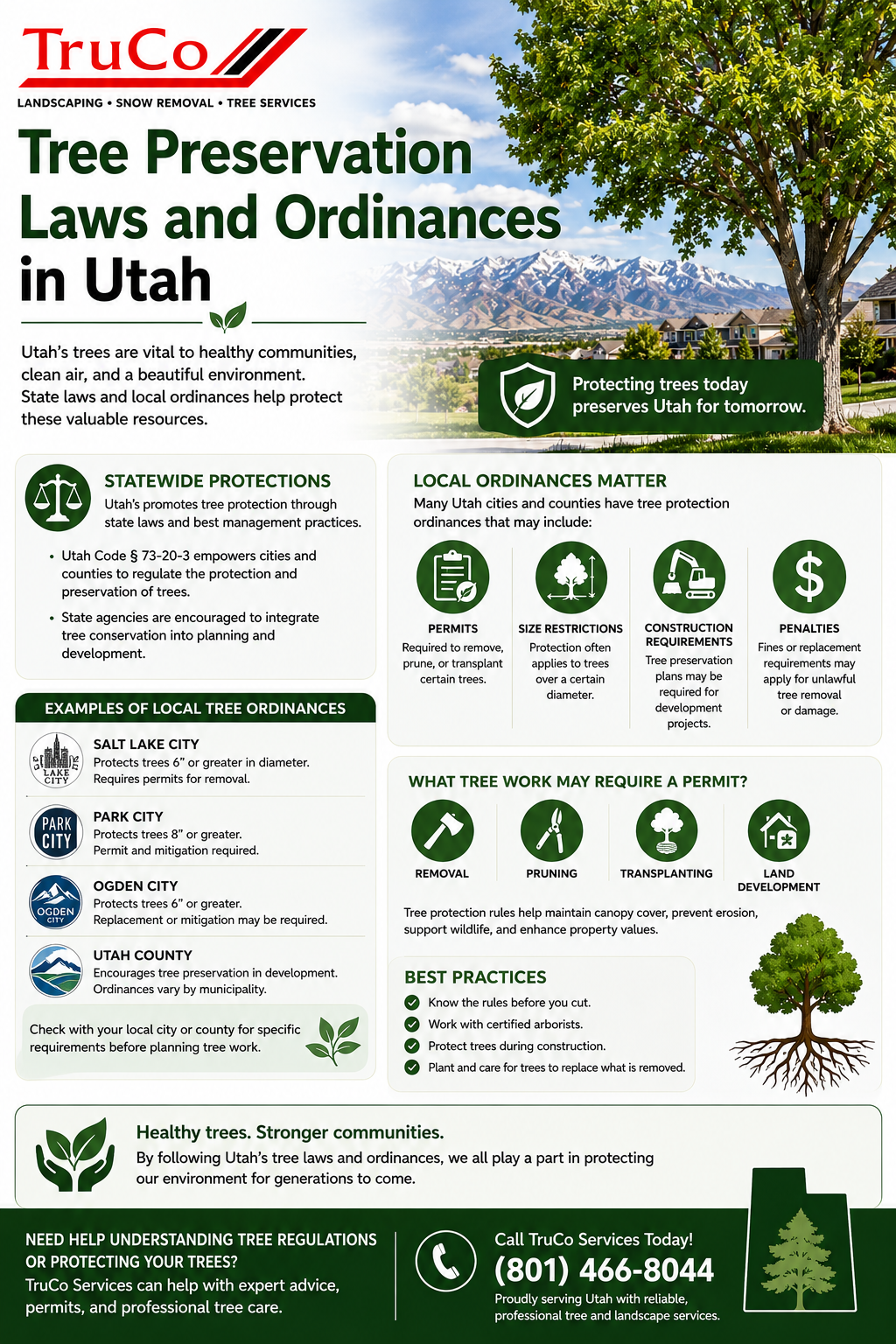
Several Utah cities are taking action to protect and expand urban tree canopy. Salt Lake City has adopted an ambitious Urban Forestry Master Plan with a goal of 30% tree canopy by 2040. The plan includes targeted tree planting in low-canopy neighborhoods, improved tree preservation during development, and increased funding for tree maintenance. Sandy City has a comprehensive tree planting program and requires developers to preserve trees or pay mitigation fees. Park City has strong tree preservation ordinances that protect trees during development and require high replacement ratios. Provo has adopted a tree canopy assessment and is developing a citywide tree planting strategy. Ogden partners with Tree Utah for community tree planting events. Tree Utah, a nonprofit organization, has planted over 20,000 trees across Utah since 1999, working with communities, schools, and volunteers. The Utah Community Forest Council advocates for urban forestry and provides resources for communities. Many Utah cities participate in the Tree City USA program, which requires a tree board or department, a tree ordinance, a community forestry budget, and an Arbor Day celebration. Over 30 Utah communities have achieved Tree City USA status.
How Homeowners Can Support Urban Tree Canopy
Individual property owners play a critical role in building and maintaining urban tree canopy. Plant climate-appropriate trees on your property — choose species that thrive in Utah's alkaline soil and semi-arid climate. Plant large-growing species where space allows — large trees provide disproportionately more canopy benefits than small trees. A single large shade tree (50+ feet tall) provides as much benefit as 10-15 small ornamental trees. Preserve existing mature trees on your property — their value far exceeds newly planted trees. Maintain the trees you have — healthy trees with full canopies provide maximum benefits. Remove invasive or problematic species and replace with desirable, long-lived trees. Participate in community tree planting events through Tree Utah or your city's tree program. Advocate for tree preservation in your neighborhood and city — attend planning meetings, support tree-friendly policies, and encourage your neighbors to plant and preserve trees. Consider planting trees in your park strip (the area between sidewalk and street) with proper permission from your city. Water trees during drought, especially young and newly planted trees. Report damaged or hazardous public trees to your city. Every tree planted and preserved in Utah's urban areas contributes to a healthier, more livable community.
The Economic Case for Urban Tree Canopy
The economic benefits of urban trees far outweigh the costs of planting and maintaining them. Property value increases — mature trees add 3-15% to property values. For a $500,000 Utah home, a well-placed mature tree can add $15,000-$75,000 in value. Energy savings — strategic tree placement reduces heating and cooling costs by 15-35%, saving Utah homeowners $200-$500 annually. Stormwater management — trees reduce stormwater infrastructure costs. The U.S. Forest Service estimates that every $1 invested in urban forestry returns $2-$5 in benefits. Tourism and economic development — tree-lined streets attract visitors, shoppers, and businesses. Studies show consumers spend 12-30% more in tree-lined commercial districts. Healthcare cost reduction — improved air quality and heat reduction from trees reduce healthcare costs related to respiratory illness and heat stress. Air quality improvement value — Utah's urban forest provides an estimated $10-20 million in annual pollution removal value. Carbon sequestration value — urban tree carbon storage in Utah is valued at millions of dollars. Long-term investment — unlike gray infrastructure (roads, buildings) that depreciates, trees appreciate over time. A $200 tree planted today can provide $2,000-$5,000 in benefits over 30 years. For Utah's growing communities, investing in urban tree canopy is one of the highest-return infrastructure investments available.
How to Measure Tree Canopy in Your Community
Understanding your community's tree canopy is the first step toward improving it. Canopy assessment methods include: aerial photography and LiDAR — the most accurate method, using satellite or aircraft imagery to map tree canopy. The U.S. Forest Service's i-Tree Canopy tool provides free canopy assessment using Google Earth imagery. GIS mapping — many Utah cities maintain GIS databases of public trees and canopy cover. Contact your city planning or public works department. Ground surveys — certified arborists can conduct ground-based canopy assessments for specific properties or neighborhoods. Volunteer assessments — community groups can use the i-Tree Canopy web app to assess canopy coverage in their neighborhoods. Community canopy goals — the American Forests organization recommends 40% canopy coverage in residential areas, 25% in urban residential areas, and 15% in commercial/industrial areas for the Intermountain West region. Most Utah cities fall short of these targets. Working toward these goals requires baseline data, goal setting, strategic planning, and community engagement. Neighborhood-level assessments can reveal disparities — many Utah cities show significant differences in canopy coverage between higher-income and lower-income neighborhoods, an environmental justice issue that can be addressed through targeted tree planting programs.
Frequently Asked Questions
What is a healthy urban tree canopy percentage for Utah? For Utah's semi-arid climate, American Forests recommends 25-40% canopy coverage in residential areas. Most Utah cities have 10-20% coverage, well below recommended levels. Each city's target should consider local climate, development patterns, and water availability.
Which Utah city has the best tree canopy? Among major Utah cities, Salt Lake City's historic neighborhoods (the Avenues, Federal Heights) have the highest canopy coverage, approaching 30-35%. Among smaller communities, Park City and Logan have strong tree canopies due to preservation efforts and favorable growing conditions.
Do trees worsen Utah's air inversion? During inversion events, trees can temporarily trap pollutants near the ground, but their overall long-term effect is positive — trees remove pollutants, cool the air (reducing ozone formation), and sequester carbon. The net air quality benefit of trees is overwhelmingly positive.
How much does it cost to plant a tree in a Utah city? Costs vary: small container trees ($25-$75), larger specimen trees ($100-$300), professional planting ($50-$150 per tree), plus watering costs for establishment. Many cities and nonprofits offer subsidized tree planting programs. Tree Utah offers trees for $30-$50 at community planting events.
Can I plant a tree on my park strip in Utah? In most Utah cities, yes, but you may need a permit. Contact your city's public works or urban forestry department. Choose appropriate species that will not interfere with power lines, sidewalk clearance, and street visibility. Some cities have approved species lists for park strip planting.
What is Tree City USA and how does it help Utah communities? Tree City USA is an Arbor Day Foundation program that recognizes communities committed to urban forestry. Benefits include access to grants, technical assistance, and public recognition. Over 30 Utah communities are Tree City USA designees. Contact the Utah Division of Forestry for application information.