
How to Get Rid of Japanese Beetles in Utah

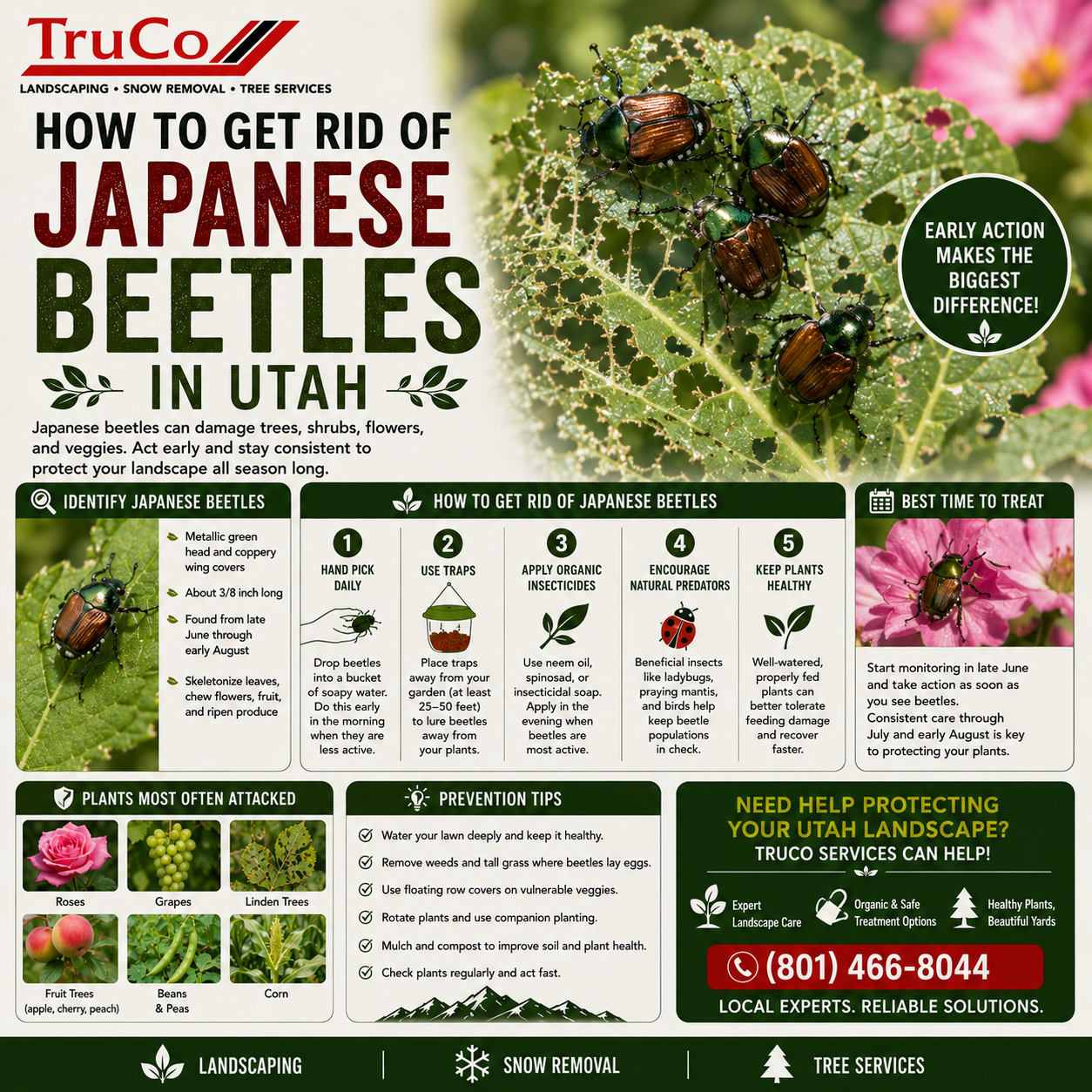
Japanese beetles are one of the most damaging garden pests in the United States, and they have become an increasing concern for Utah homeowners in recent years. These metallic green-and-copper beetles feed in swarms, skeletonizing leaves, shredding flowers, and devouring fruit on dozens of plant species. Because they feed in groups and return year after year, a Japanese beetle infestation can quickly ruin roses, fruit trees, grapevines, and ornamental shrubs. The good news is that Japanese beetles are manageable with a combination of strategies, and Utah's drier climate helps slow their spread. This guide covers how to identify Japanese beetles and their damage, their life cycle in Utah, the plants they attack, and every practical control method — from handpicking and traps to milky spore, beneficial nematodes, and targeted insecticides. With a season-long program, you can protect your Utah landscape from these voracious pests.
How to Identify Japanese Beetles
Japanese beetles are easy to recognize. Adults are about 1/2 inch long with a shiny metallic green head and thorax and copper-brown wing covers, with small white tufts of hair along the abdomen. They emerge in late spring to early summer and feed in large groups, especially on warm, sunny days. The damage is distinctive: they chew leaf tissue between the veins, leaving a skeletonized, lace-like pattern. They also feed on flower petals, buds, and fruit, and they are attracted to ripening fruit on peaches, apples, grapes, and raspberries. Grubs, the larval stage, are C-shaped, cream-colored larvae with brown heads that live in the soil and feed on grass roots, causing brown patches in lawns. Adults live for about 30-45 days, and in Utah they are most active from late June through August. To confirm an infestation, look for skeletonized leaves, clusters of beetles on plants, and grubs when digging in lawn edges. Early identification — while populations are small — makes control far more effective in Utah gardens.
Japanese Beetle Life Cycle in Utah
Understanding the Japanese beetle life cycle is the key to timing your control. Adults emerge from the soil in late spring to early summer — typically late June in Utah — and immediately begin feeding and mating. Females lay eggs in moist, grassy soil in July and August, choosing lawns, irrigated turf, and garden beds. The eggs hatch into grubs that feed on grass roots through late summer, then burrow deeper to overwinter. The following spring, grubs move up near the surface, feed briefly, and pupate, emerging as adults to start the cycle again. This one-year life cycle means effective control targets two windows: adult beetles during the summer feeding season, and grubs in late summer or early fall when they are young and near the surface. Adult control protects your plants immediately, while grub control reduces next year's population. In Utah, where lawns are heavily irrigated, grubs thrive in watered turf. Monitoring for adults starting in late June, and treating grubs in August through September, gives you year-round leverage on the pest. Understanding this cycle lets Utah gardeners control both the beetles you see and the grubs you don't.
Plants Most Damaged by Japanese Beetles
Japanese beetles are generalist feeders that attack more than 300 plant species, but they have clear favorites. Roses are among the most heavily damaged — beetles devour petals and skeletonize leaves, often ruining blooms within days. Fruit trees including peach, cherry, plum, apple, and pear are attacked, and grapes and raspberries suffer serious damage to foliage and fruit. Ornamental trees and shrubs such as linden, crabapple, birch, elm, maple, and hibiscus are favored hosts, and linden trees can be completely defoliated. Perennials including hibiscus, hollyhock, phlox, and Virginia creeper are common targets, and beans, corn, and other vegetables may be damaged. Conversely, Japanese beetles tend to avoid plants like boxwood, lilac, dogwood, holly, and many evergreens, as well as strongly scented herbs. In mixed Utah landscapes, plant less-preferred species in high-traffic areas, protect favored plants with row covers or netting during peak beetle season, and concentrate control efforts on the plants beetles love most. Knowing which plants are at risk helps you prioritize protection where damage hits hardest in your Utah garden.
Natural and Organic Japanese Beetle Control
Start with mechanical and biological controls, which are safe for people, pets, and beneficial insects. Handpicking is highly effective for small gardens: in the early morning when beetles are sluggish, shake them off plants into a bucket of soapy water, or pick them directly — a single beetle can be squished or dropped in soapy water, and since beetles release aggregation pheromones when disturbed, removing them discourages others from landing. Use row covers or fine netting on prized plants during peak beetle season to exclude them. Japanese beetle traps, which use pheromone lures, are widely sold, but use them with caution — they attract beetles from a wide area and can make infestations worse if placed near valued plants; place traps at the edge of the property, far from gardens, and empty them daily. For grubs, milky spore disease (Bacillus popilliae) is a biological control that infects and kills grubs over several years, and beneficial nematodes applied to soil in late summer target young grubs effectively. Encourage natural predators like birds, and keep plants healthy so they tolerate feeding. These natural methods, used together, keep most Utah Japanese beetle populations manageable.
Chemical Control for Japanese Beetles
For heavy infestations, targeted insecticides provide fast relief. Adult beetles can be controlled with products containing carbaryl (Sevin), pyrethrins, bifenthrin, or neem oil — neem and pyrethrins are gentler options for gardens and less harmful to bees when applied carefully. Spray in the early morning or evening when bees are less active, and reapply after rain. For grubs in lawns, products containing imidacloprid, chlorantraniliprole, or halofenozide applied in late summer to early fall kill young grubs before they burrow deep; spring treatments are less effective. Milky spore and nematodes are biological grub-control options that work over time. Avoid broad-spectrum products near blooming plants to protect pollinators. For large trees or widespread infestations, contact your county extension office or a licensed pest control professional about area-wide treatment — community cooperation is often necessary because beetles fly freely between properties. Always follow label instructions exactly and use the least-toxic effective option. Chemical control works best as part of an integrated program combining handpicking, exclusion, and grub control for lasting results in Utah landscapes.
Japanese Beetle Control by Season
Managing Japanese beetles in Utah requires a season-long approach. In late summer and early fall, apply grub controls — beneficial nematodes, milky spore, or targeted insecticides — to young grubs near the soil surface, and water them in well. Through fall and winter, grubs overwinter deep in soil; reduce lawn watering stress and let the cycle rest. In early spring, as soil warms, grubs move up to feed briefly on roots — you can apply preventive grub treatments now in high-risk lawns, though late-summer applications are more effective. In late spring, watch for adult emergence, typically late June in Utah, and begin monitoring favored plants daily. Through summer, handpick beetles in the morning, protect prized plants with row covers, and place traps only at the edges of the property. Harvest ripening fruit promptly, since ripe fruit attracts beetles. In fall, clean up plant debris, rake and remove fallen fruit, and apply grub control to break the cycle. In outbreak years, combine every available method — handpicking, exclusion, biological, and chemical — because no single tactic stops a heavy infestation. With a season-long strategy, Utah gardeners can protect their landscapes through Japanese beetle season.
What do Japanese beetles look like? About half an inch long with metallic green heads and copper-brown wing covers, plus small white tufts along the abdomen. They feed in groups on leaves, flowers, and fruit.
Are Japanese beetles in Utah? Yes — Japanese beetles have been detected in Utah and are spreading in the region. Their populations can grow quickly where lawns are irrigated and host plants are abundant.
What kills Japanese beetles? Handpicking into soapy water, neem oil, pyrethrins, carbaryl, and bifenthrin for adults. For grubs, use milky spore, beneficial nematodes, or imidacloprid in late summer.
Do Japanese beetle traps work? Traps attract beetles from a wide area and can worsen infestations. If you use them, place them at the edge of the property, far from plants you want to protect, and empty daily.
When do Japanese beetles come out in Utah? Adults typically emerge in late June and are active through August. This is the window to handpick and protect vulnerable plants.
How do I get rid of Japanese beetle grubs in my lawn? Apply beneficial nematodes or milky spore in late summer to early fall, or use imidacloprid-based products; water them in well to reach the root zone.