
Tree Selection Guide for Small Urban Yards in Utah

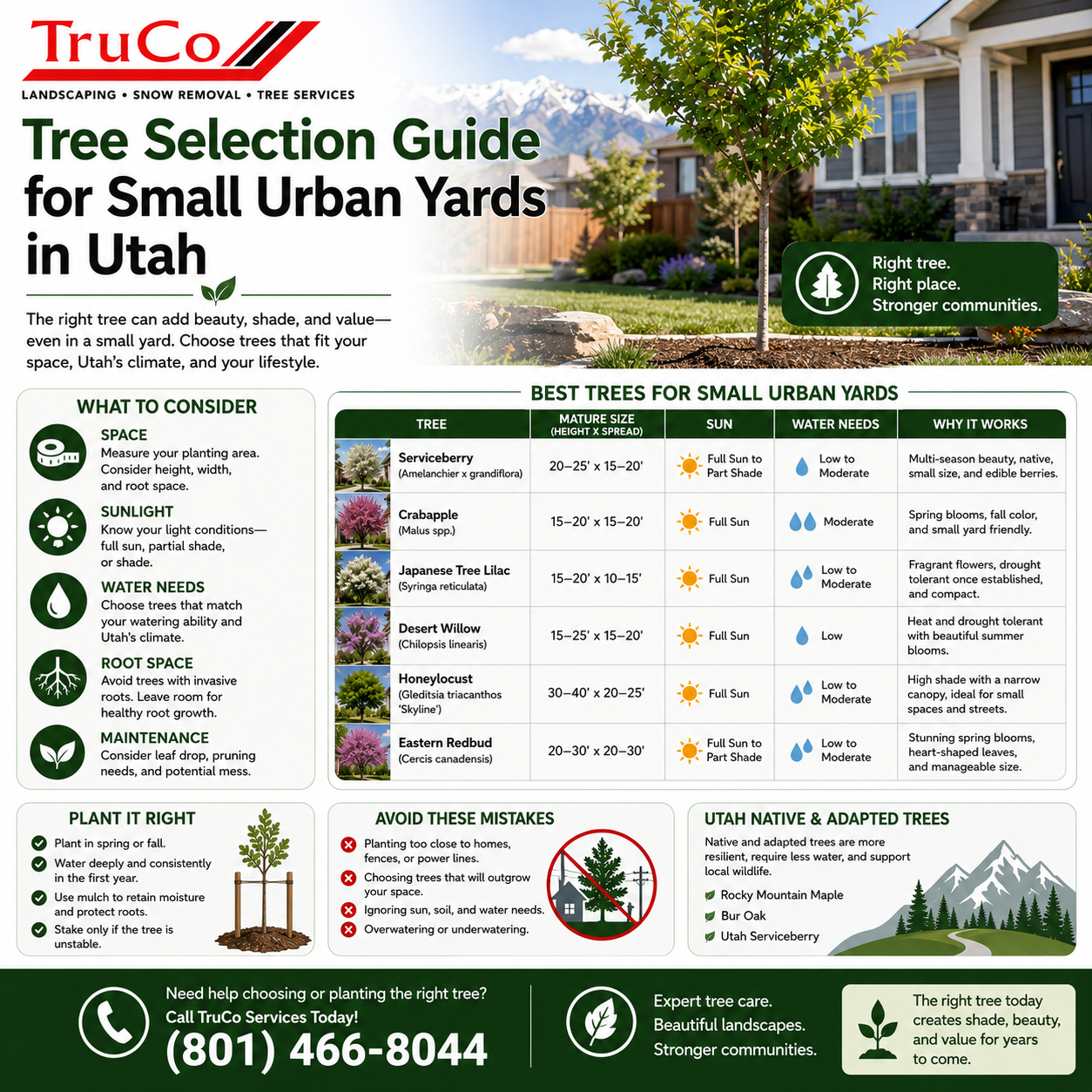
Why Tree Selection Matters for Small Urban Yards
Choosing the right tree for a small urban yard in Utah is one of the most important landscaping decisions you will make. A tree that outgrows its space can damage foundations, block views, interfere with power lines, and become a maintenance burden. Conversely, a well-chosen tree enhances your property, provides shade and beauty, and increases home value without causing problems. Utah's growing cities — from Salt Lake City's compact lots to the newer suburban developments in Utah County — present unique challenges for tree selection. Limited space, alkaline clay soil, dry climate, and urban heat island effects all influence which trees will thrive. This guide focuses specifically on tree selection for small Utah yards (under 5,000 square feet), townhomes, and urban lots where space is at a premium. Following these guidelines will help you choose a tree that fits your space for its entire life, avoiding the costly and difficult process of removing an overgrown tree 20 years from now.
Key Factors for Small Yard Tree Selection
When selecting a tree for a small Utah yard, consider these critical factors. Mature size — the most important factor. Choose a tree whose mature height and spread will fit your available space. A tree that reaches 20 feet tall and 15 feet wide needs significantly less room than one reaching 50 feet tall. Consider both above-ground size (height, spread) and below-ground size (root spread). Root system — some trees have aggressive, invasive roots that can damage foundations, sidewalks, and underground utilities. Avoid poplars, willows, silver maples, and Siberian elms in small yards. Choose trees with non-invasive root systems. Growth rate — faster-growing trees often have weaker wood and shorter lifespans. Slower-growing trees are typically stronger and longer-lived. For small yards, a moderate growth rate is ideal. Utah hardiness — the tree must survive Utah's USDA zones 4-7 (depending on your location), tolerate alkaline soil (pH 7.5-8.5), and handle drought once established. Maintenance needs — consider pruning requirements, fruit or seed cleanup, pest susceptibility, and water needs. Low-maintenance trees are best for small yards. Aesthetic qualities — consider seasonal interest (flowers, fall color, bark, form), shade density, and how the tree complements your home and landscape. Function — what do you want the tree to do? Provide shade, create privacy, frame your home, or add seasonal color? Choose a tree that serves your specific needs.
Top Small Trees for Utah Yards (Under 25 Feet)
These trees reach 25 feet or less at maturity and are excellent choices for small Utah yards. Amur maple (Acer tataricum subsp. ginnala) — 15-20 feet tall, brilliant red fall color, tolerates clay, drought, and alkaline soil. Very hardy (Zone 3). Ideal for small yards as a specimen or small shade tree. Japanese tree lilac (Syringa reticulata) — 20-25 feet tall, creamy white flower clusters in June, attractive bark. Extremely adaptable to Utah conditions, including urban pollution and alkaline soil. Serviceberry (Amelanchier alnifolia) — 15-25 feet tall, white spring flowers, edible berries, yellow-orange fall color. Utah native, extremely adaptable, multi-season interest. Excellent for naturalistic landscapes. Eastern redbud (Cercis canadensis) — 20-30 feet tall, pink-purple spring flowers before leaves emerge. Tolerates Utah alkaline soil in protected microclimates. Beautiful specimen tree. Hawthorn (Crataegus species) — 15-25 feet tall, spring flowers, persistent red fruit, good fall color. Tolerant of clay and alkaline conditions. Choose disease-resistant cultivars. Goldenrain tree (Koelreuteria paniculata) — 25-35 feet tall, yellow summer flowers, papery seed pods. Tolerates heat, drought, and alkaline soil. Good for warmer Utah microclimates. Crape myrtle (Lagerstroemia) — 10-20 feet tall depending on cultivar, long summer bloom period, attractive bark. Choose hardy varieties for Utah Zone 5-6. Plant in protected, warm locations.
Medium Trees for Slightly Larger Urban Yards (25-40 Feet)
If you have a bit more space (yards over 3,000 square feet), these medium trees work well. Honeylocust (Gleditsia triacanthos inermis) — 30-40 feet tall, dappled shade, excellent fall color. Extremely adaptable to Utah conditions — tolerates clay, alkaline soil, drought, and urban pollution. Thornless, seedless varieties like 'Shademaster' and 'Skyline' are ideal. Chinese elm (Ulmus parvifolia) — 35-40 feet tall, graceful form, attractive exfoliating bark. Tolerates clay, drought, and alkaline soil. Disease-resistant alternative to American elm. Kentucky coffeetree (Gymnocladus dioicus) — 30-40 feet tall, bold texture, late-emerging leaves let spring bulbs get sun. Extremely tough and adaptable. Male cultivars (like 'Espresso') are seedless. Japanese pagoda tree (Styphnolobium japonicum) — 30-40 feet tall, late summer white flowers, attractive form. Tolerates urban conditions, alkaline soil, and drought once established. Crabapple (Malus species) — 15-25 feet tall depending on cultivar, spectacular spring bloom, ornamental fruit, good fall color. Choose disease-resistant cultivars like 'Prairiefire,' 'Sugar Tyme,' or 'Spring Snow.' Excellent for small yards with full sun.
Trees to Avoid in Small Utah Yards
Several tree species are problematic for small urban yards in Utah. Avoid silver maple (Acer saccharinum) — fast-growing but weak wood, aggressive roots that invade sewers and lift sidewalks, and susceptible to storm damage. Cottonwood (Populus deltoides) — enormous mature size (60-80+ feet), invasive roots that seek water, constant branch drop, and short lifespan (30-50 years in urban settings). Siberian elm (Ulmus pumila) — invasive, weak-wooded, seeds prolifically, and susceptible to elm leaf beetle. Poplars (Populus species) — aggressive roots that damage foundations and pipes, short-lived, and prone to canker diseases. Weeping willow (Salix babylonica) — invasive roots seek water, weak wood, and needs constant moisture — unsuitable for small Utah yards. Box elder (Acer negundo) — weak wood, attracts box elder bugs, seeds prolifically, and short-lived. Black walnut (Juglans nigra) — produces juglone that kills many other plants, large mature size, and messy fruit. Tree of heaven (Ailanthus altissima) — invasive, aggressive, produces allelopathic chemicals, and has unpleasant odor. These species are best avoided in small urban spaces — the problems they cause far outweigh their benefits.
Tree Placement in Small Yards
Proper placement maximizes the benefits of a tree while minimizing potential problems. Distance from buildings — plant small trees (under 25 feet) at least 10-15 feet from buildings. Plant medium trees (25-40 feet) at least 15-20 feet from buildings. These distances allow for mature canopy spread without branches touching the house and provide room for root systems. Distance from power lines — plant only small trees (under 20 feet) directly under power lines. Maintain at least 15-foot clearance from utility poles. Distance from driveways and sidewalks — plant trees at least 5-10 feet from paved surfaces to avoid root damage and canopy obstruction. Sun orientation — plant deciduous trees on the south and west sides of your home for summer shade and winter sun. Consider neighbor's views — choose tree placement that will not block your neighbor's views or sun. Consider your own views — position the tree to frame desired views and screen unwanted ones. Multiple small trees — in a small yard, one well-placed tree is often better than several poorly placed ones. If you want multiple trees, choose smaller species and space them appropriately. Focal points — use trees to draw attention to your home's entrance, frame a view, or create a welcoming arrival. Avoid overcrowding — give each tree room to reach its natural form without competing with other plants.
Root Considerations for Small Urban Lots
Root systems are often overlooked when selecting trees for small yards, but they cause many of the most expensive problems. In Utah's clay soil, tree roots tend to grow wide and shallow — often extending 2-3 times the canopy diameter. For a small urban lot, this means the root system of a medium or large tree will extend well beyond your property lines. Choose trees with non-invasive root systems — honeylocust, serviceberry, Japanese tree lilac, Amur maple, and crabapples have relatively non-aggressive root systems. Avoid trees known for aggressive roots — poplars, willows, silver maple, cottonwood, Siberian elm. Consider root barriers if planting near foundations, driveways, or underground utilities. Root barriers are physical sheets installed vertically in the soil to redirect roots downward and away from structures. Plant trees at least 10-15 feet from underground utility lines. Call 811 before digging to mark utilities. Remember that in small yards, roots from neighboring trees may already occupy much of the soil volume — your new tree will need to compete for water and nutrients. This is another reason to choose smaller, less aggressive tree species for urban lots.
Planting and Establishing Trees in Urban Environments
Urban environments in Utah present additional challenges for tree establishment. Soil quality in urban lots is often poor — compacted from construction, mixed with debris, and lacking organic matter. Before planting, amend the soil with compost and consider raised planting beds for improved drainage. In urban heat islands (downtown areas, large paved areas), trees experience higher temperatures and more drought stress. Choose heat-tolerant species and provide extra water. Urban trees often receive less water than their suburban counterparts due to smaller planting areas and heat-reflecting surfaces. Install drip irrigation or soaker hoses for consistent watering. Protect trees from urban pollutants — road salt, vehicle exhaust, and construction dust. Choose pollution-tolerant species. Consider overhead constraints — power lines, building overhangs, and signs may limit tree height. Choose species that will not outgrow their overhead space. Underground constraints — utility lines, drainage fields, and underground structures may limit root space. Call 811 before planting to locate utilities. Give newly planted urban trees extra care — they face more stress than trees in suburban or rural settings. Consistent watering, mulching, and protection during the establishment period are even more critical in urban environments.
Frequently Asked Questions
What is the best tree for a small front yard in Utah? For a small front yard (under 500 square feet of planting space), choose a tree that matures under 20 feet. Japanese tree lilac, Amur maple, or serviceberry are excellent choices. They provide seasonal interest, stay compact, and are well-adapted to Utah conditions.
How close to my house can I plant a tree in Utah? Small trees (under 25 feet mature height): 10-15 feet from the house. Medium trees (25-40 feet): 15-20 feet from the house. Large trees (over 40 feet): 25-35 feet from the house. These distances minimize root and branch conflicts with your home.
What tree has non-invasive roots for small yards? Honeylocust, serviceberry, Japanese tree lilac, Amur maple, crabapple, and Kentucky coffeetree have relatively non-invasive root systems. Avoid poplars, willows, silver maple, and cottonwood, which have aggressive roots.
Can I plant a fruit tree in a small Utah yard? Yes. Dwarf and semi-dwarf fruit trees (apple, pear, cherry, peach) can be excellent choices for small yards. They provide beautiful spring blooms and edible fruit. However, they require more maintenance (pruning, spraying, watering) than ornamental trees.
What is the fastest-growing small tree for Utah? Among small trees, Amur maple and goldenrain tree have relatively fast growth rates (1-2 feet per year). However, remember that fast-growing trees often have shorter lifespans. A moderate growth rate of 12-18 inches per year is ideal for small yards.
Do I need to consider my neighbor's property when planting a tree? Yes. Plant trees far enough from property lines that mature branches and roots will not cause problems on your neighbor's side. In Utah, if your tree causes damage to your neighbor's property, you may be liable. Good communication with neighbors about tree placement is always recommended.